

There is this saying called the Three Gates of Speech which I have always admired. It is often attributed to the Sufi scholar Rumi and goes something like this:
Before you speak, let your words pass through three gates: At the first gate, ask yourself “Is is true?” At the second gate ask, “Is it necessary?” At the third gate ask, “Is it kind?”
Just like this, I think we should always have procedural and documented ways of handling tasks, call it the SOPs of our behavior! And if we let our speeches be unfettered, we have all seen the damage speeches can cause! People can use these words to rouse hoards of people to a mob-like mentality and while on the other end of the spectrum politicians can go about twisting and turning their words like clay as they please because they know they are no consequences.
Similarly, I believe we can use such an approach to handle issues like failure. If a person has no code to adhere to when facing failure, it can lead to them falling in the same pitfalls repeatedly and if taken too deeply may even lead to a downward spiral of depression. I have proposed a similar three gate structure to handling failure. These steps are not exhaustive and certainly not set in stone but should be enough for a general blueprint.
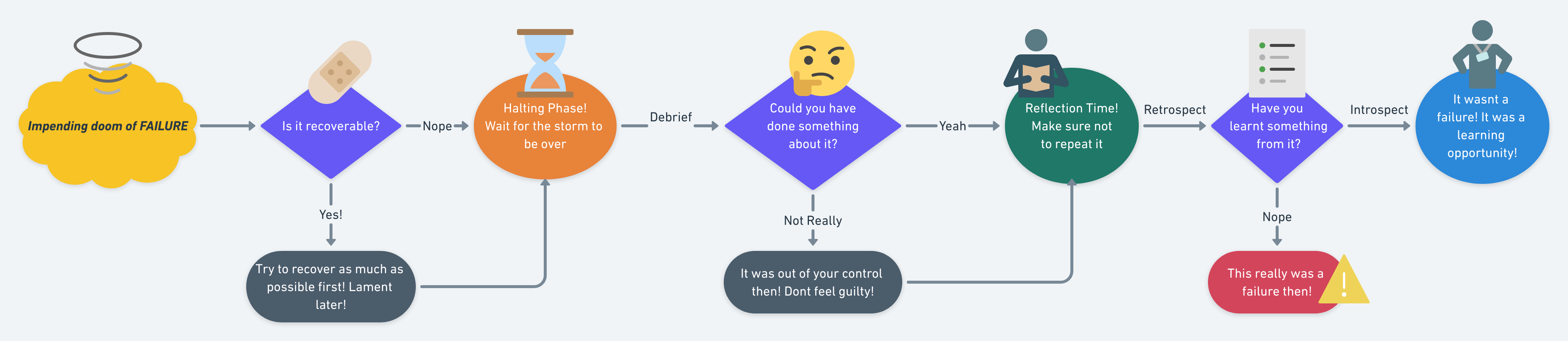
It goes like this, whenever you encounter failure ask yourself these three questions:
- Is it recoverable?
- Could you have done something about it?
- Have you learnt something from it?
For each of these checkpoints there are corresponding actions you must take;
#1: The Gate of Recovery
Do not leave until all holes have been plugged and the worst of the storm is over. First try to extinguish all the burning fires and have an objective frame of mind as to what can I do to minimize my losses.
But once the immediate threat is over, then we need to have the halting phase like shown in the diagram which is the most important, we need to let some passage of time to happen before we start jumping to conclusions. Otherwise, all we have is prejudiced premature responses not backed by reason or rationale which leads to a whole lot of pointing fingers and minimal learning, if at all.
One example I have over here is that whenever you receive an angry email we have always found that rather than writing an instantaneous rash reply (which you end up regretting later), it is much better to have a sleep on it and later you realize what kind of embarrassing decision it would have been if you had sent i immediately.
#2: The Gate of Recall
Once the storm has been weathered, and time has passed, it is time to recall what went wrong and debrief. It is crucial for us to first ask the question before we start attributing fault , that was there something that could have been done? If a natural disaster wrecks your entire home, you could have taken safety precautions, but sometimes things happen that are out of your locus of control. The sooner we can acclimatize us with that , the better. And then we need to adopt a strategy that I’d like to bundle together as retrospection and introspection, in which we need to look in the past and see what happened. Aircraft investigations are perhaps the best examples of this as investigators try to turn back in time and see what went wrong and more importantly can such issues be reproduced and if so how can we stop them from happening as soon as possible. Most companies and people often have dedicated processes set aside for such steps. For example, in tech companies usually there is a process known as a Retro in which you retrospectively look back and see what went wrong (software deliverables were delayed, bugs came up in production, etc) and how can we prevent those things in the future. The important part here is to realize the fact that we must not be looking for someone ‘blame-worthy’ but rather taking the mistakes as a team and moving forward.
#3: The Gate of Reform
Lastly i think the word failure or at least the usual connotation attached to it is usually a misnomer. These aren’t Failures but Learning Opportunities. If you have come out of this as a changed person and have some learnings and takeaways then this was simply a bump in your learning curve, a test to check your car’s suspension system, if you will. If we do not take this as time for improvement then that will indeed be the true failure.
Side note: A lot of the things I’ve said here might seem obvious at first glance (especially to me) and I was wondering if this is common knowledge or not? But i think that by simply saying it out loud it can serve as a reminder and help us internalize it to never take failures personally and always have a process to handle them which really makes the job much easier.